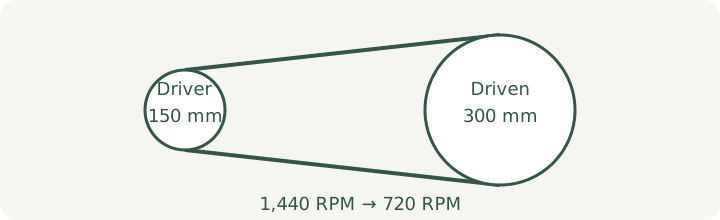
WORKED FIELD EXAMPLE · HYPOTHETICAL
How much faster will a different pulley run?
Assume a 1,500 RPM motor, a 100 mm driving pulley and a 200 mm driven pulley.
1. Enter the conditions
Select Korea · SI and enter speed 1,500, driver diameter 100 and driven diameter 200. The theoretical driven speed is 750 RPM. Change the driven diameter to 150 and the result is 1,000 RPM.
2. Interpret the result
Reducing the driven diameter while retaining the driver increases driven speed. Accidentally swapping the original diameters gives 3,000 RPM, so identify which shaft drives the belt first.
3. Check before applying
Use manufacturer-specified effective or pitch diameters. Slip, load, belt length, tension and speed ratings are outside this calculation. Stop and isolate the machine before inspecting pulleys.
How to use
Enter driver speed and both effective pulley diameters in the same unit.
Worked example
1,500 RPM × 4 inch ÷ 8 inch = 750 RPM. The same ratio applies to 100 mm and 200 mm.
Application notes
Belt slip is excluded. Use pitch diameters rather than outside diameters where available.
Workshop examples
Workshop example: belt-driven fan
At 1,500 driver RPM with a 100 mm driver and 200 mm driven pulley, output is 1,500 × 100 ÷ 200 = 750 RPM. Use manufacturer pitch diameters where available.
Workshop example: smaller driven pulley
Changing the driven pulley to 150 mm gives 1,500 × 100 ÷ 150 = 1,000 RPM. Before changing hardware, check fan, motor and belt speed ratings and load requirements.
Frequently asked questions
Which pulley is the driver?
The motor pulley transmitting power is the driver. The pulley receiving power on the fan or machine is the driven pulley.
Can I mix millimeters and inches?
Use the same unit for both diameters. Ratios such as 100/200 mm and 4/8 inches produce the same speed result.
Why does measured RPM differ?
Belt slip, diameter measurement conventions, actual motor speed and load can affect the result. The calculation assumes no slip.
More calculators