WORKED FIELD EXAMPLE · HYPOTHETICAL
Read rated torque from motor nameplate power and RPM
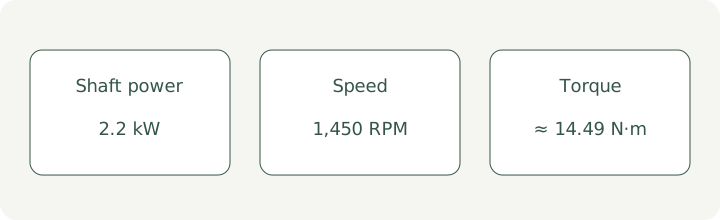
Assume a motor rated at 2.2 kW mechanical shaft output and 1,500 RPM. Use shaft output, not electrical input measured at a power meter.
1. Enter the conditions
Select Korea · SI. Enter power 2.2 and speed 1,500. Calculated torque is approximately 14.01 N·m.
2. Interpret the result
At the same 2.2 kW and 750 RPM, the equation gives approximately 28.01 N·m. This is a mathematical comparison, not a claim that the same motor maintains that power at low speed.
3. Check before applying
Check the motor and drive speed–torque curves and cooling conditions for actual low-speed operation. This is neither starting torque nor gearbox output torque.
How to use
Korea uses kW and N·m; United States uses mechanical hp and lb·ft. Enter shaft power and RPM.
Worked example
2 hp at 1,500 RPM → about 7.0028 lb·ft. Metric example: 1.5 kW at 1,500 RPM → about 9.5493 N·m.
Application notes
Use mechanical shaft power rather than electrical input power. Starting torque, peak torque and gearbox losses require separate consideration.
Workshop examples
Workshop example: 1.5 kW motor
At 1.5 kW shaft power and 1,450 RPM, torque is 1.5 × 60,000 ÷ (2π × 1,450) ≈ 9.8786 N·m. Rated shaft power and rated speed describe the rated operating condition.
Workshop example: equal power at two speeds
At 1.5 kW shaft power, torque is about 9.5493 N·m at 1,500 RPM and 19.0986 N·m at 750 RPM. This assumes the same shaft power is available at both speeds; lowering speed with a drive does not guarantee this torque.
Frequently asked questions
Can I enter power meter readings?
Electrical input differs from mechanical shaft power. You need efficiency to estimate shaft power from electrical input. Enter shaft power in this calculator.
Is the result starting torque?
No. It is torque corresponding to the entered shaft power and speed. Use manufacturer performance data for starting or maximum torque.
Which US units are used?
The US setting uses mechanical horsepower (hp) and lb·ft. Metric horsepower (PS) is different; check the power unit before entering values.
More calculators